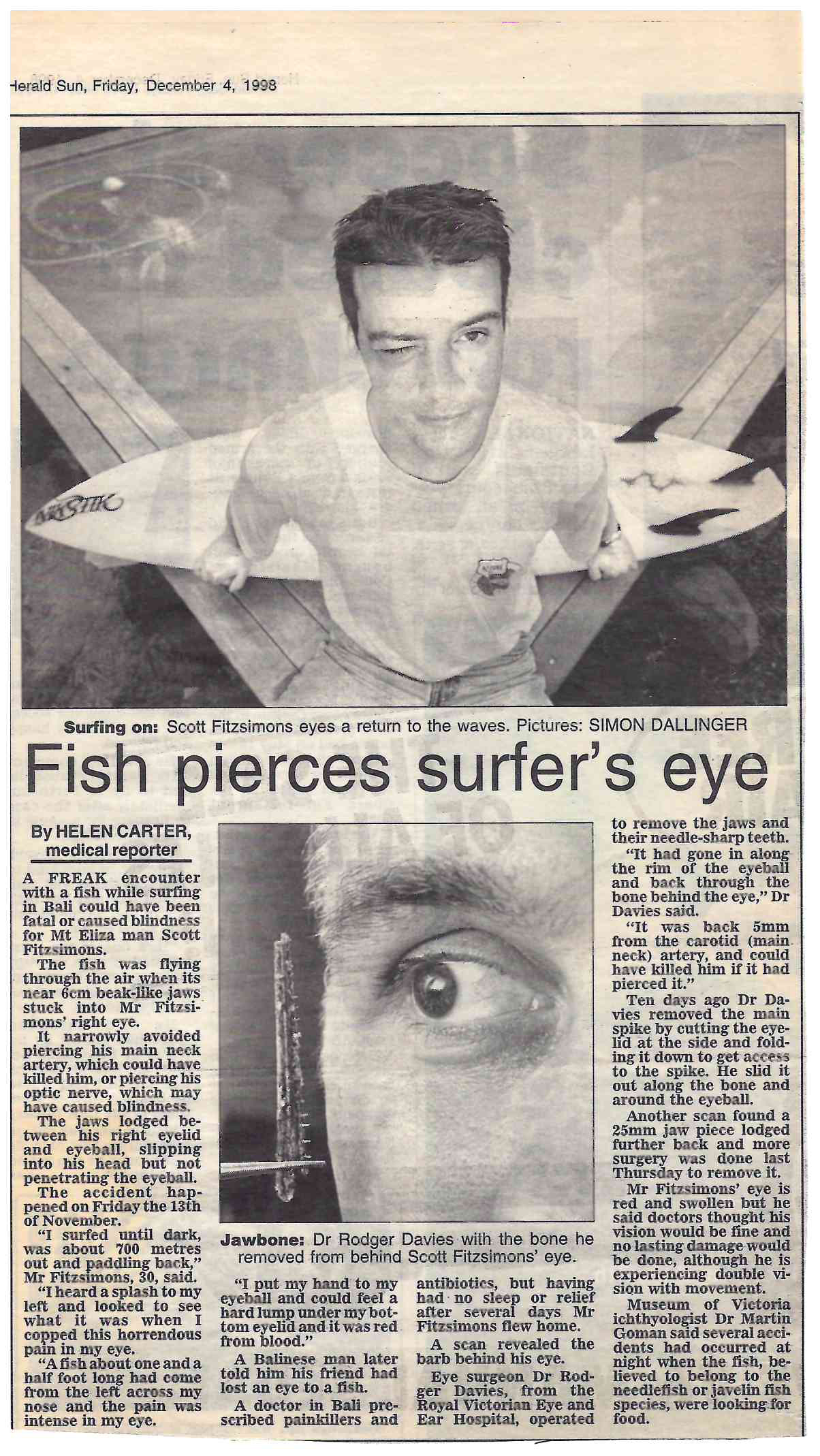
Herald Sun, Friday, December 4, 1998
By HELEN CARTER, medical reporter
A FREAK encounter with a fish while surfing in Bali could have been fatal or caused blindness for Mt Eliza man Scott Fitzsimons. The fish was flying through the air when its near 6cm beak-like jaws stuck into Mr Fitzsimons’ right eye.
It narrowly avoided piercing his main neck artery, which could have killed him, or piercing his optic nerve, which may have caused blindness. The jaws lodged between his right eyelid and eyeball, slipping into his head but not penetrating the eyeball.
The accident happened on Friday the 13th of November. “I surfed until dark, was about 700 metres out and paddling back,” Mr Fitzsimons, 30, said. “I heard a splash to my left and looked to see what it was when I copped this horrendous pain in my eye. A fish about one and a half foot long had come from the left across my nose and the pain was intense in my eye.
“I put my hand to my eyeball and could feel a hard lump under my bottom eyelid and it was red from blood.” A Balinese man later told him his friend had lost an eye to a fish. A doctor in Bali prescribed painkillers and antibiotics, but having had no sleep or relief after several days Mr Fitzsimons flew home.
A scan revealed the barb behind his eye. Eye surgeon Dr Rodger Davies, from the Royal Victorian Eye and Ear Hospital, operated to remove the jaws and their needle-sharp teeth. “It had gone in along the rim of the eyeball and back through the bone behind the eye,” Dr Davies said. “It was back 5mm from the carotid (main neck) artery, and could have killed him if it had pierced it.”
Ten days ago Dr Davies removed the main spike by cutting the eyelid at the side and folding it down to get access to the spike. He slid it out along the bone and around the eyeball. Another scan found a 25mm jaw piece lodged further back and more surgery was done last Thursday to remove it.
Mr Fitzsimons’ eye is red and swollen but he said doctors thought his vision would be fine and no lasting damage would be done, although he is experiencing double vision with movement. Museum of Victoria ichthyologist Dr Martin Goman said several accidents had occurred at night when the fish, believed to belong to the needlefish or javelin fish species, were looking for food.
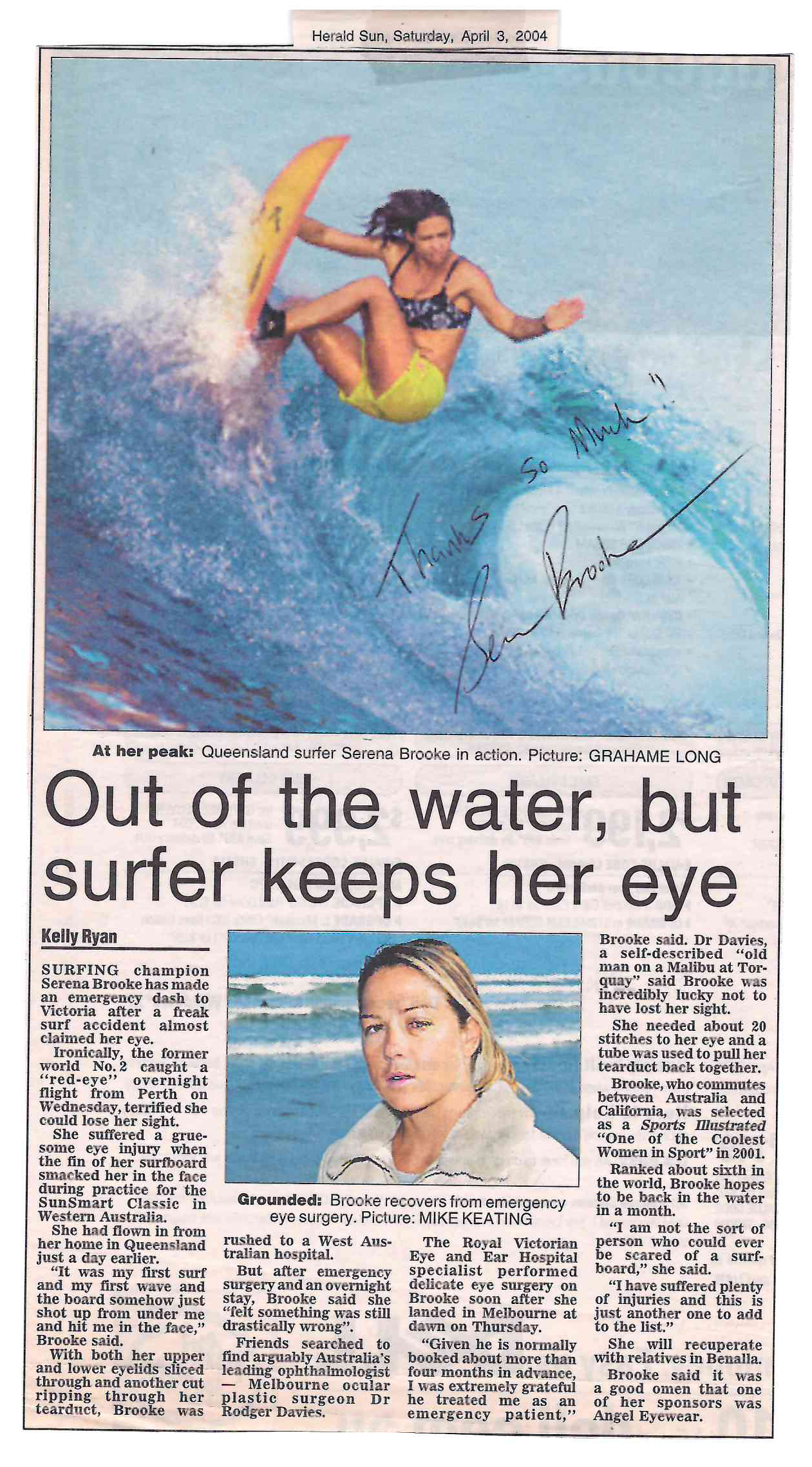
Out of the water, but surfer keeps her eye
Herald Sun, Saturday, April 3, 2004
Kelly Ryan
SURFING champion Serena Brooke has made an emergency dash to Victoria after a freak surf accident almost claimed her eye. Ironically, the former world No.2 caught a “red-eye” overnight flight from Perth on Wednesday, terrified she could lose her sight. She suffered a gruesome eye injury when the fin of her surfboard smacked her in the face during practice for the SunSmart Classic in Western Australia. She had flown in from her home in Queensland just a day earlier.
“It was my first surf and my first wave and the board somehow just shot up from under me and hit me in the face,” Brooke said. With both her upper and lower eyelids sliced through and another cut ripping through her tearduct, Brooke was rushed to a West Australian hospital. But after emergency surgery and an overnight stay, Brooke said she “felt something was still drastically wrong”. Friends searched to find arguably Australia’s leading ophthalmologist — Melbourne ocular plastic surgeon Dr Rodger Davies.
The Royal Victorian Eye and Ear Hospital specialist performed delicate eye surgery on Brooke soon after she landed in Melbourne at dawn on Thursday. “Given he is normally booked about more than four months in advance, I was extremely grateful he treated me as an emergency patient,” Brooke said. Dr Davies, a self-described “old man on a Malibu at Torquay” said Brooke was incredibly lucky not to have lost her sight. She needed about 20 stitches to her eye and a tube was used to pull her tearduct back together.
Brooke, who commutes between Australia and California, was selected as a Sports Illustrated “One of the Coolest Women in Sport” in 2001. Ranked about sixth in the world, Brooke hopes to be back in the water in a month. “I am not the sort of person who could ever be scared of a surfboard,” she said. “I have suffered plenty of injuries and this is just another one to add to the list.” She will recuperate with relatives in Benalla. Brooke said it was a good omen that one of her sponsors was Angel Eyewear.
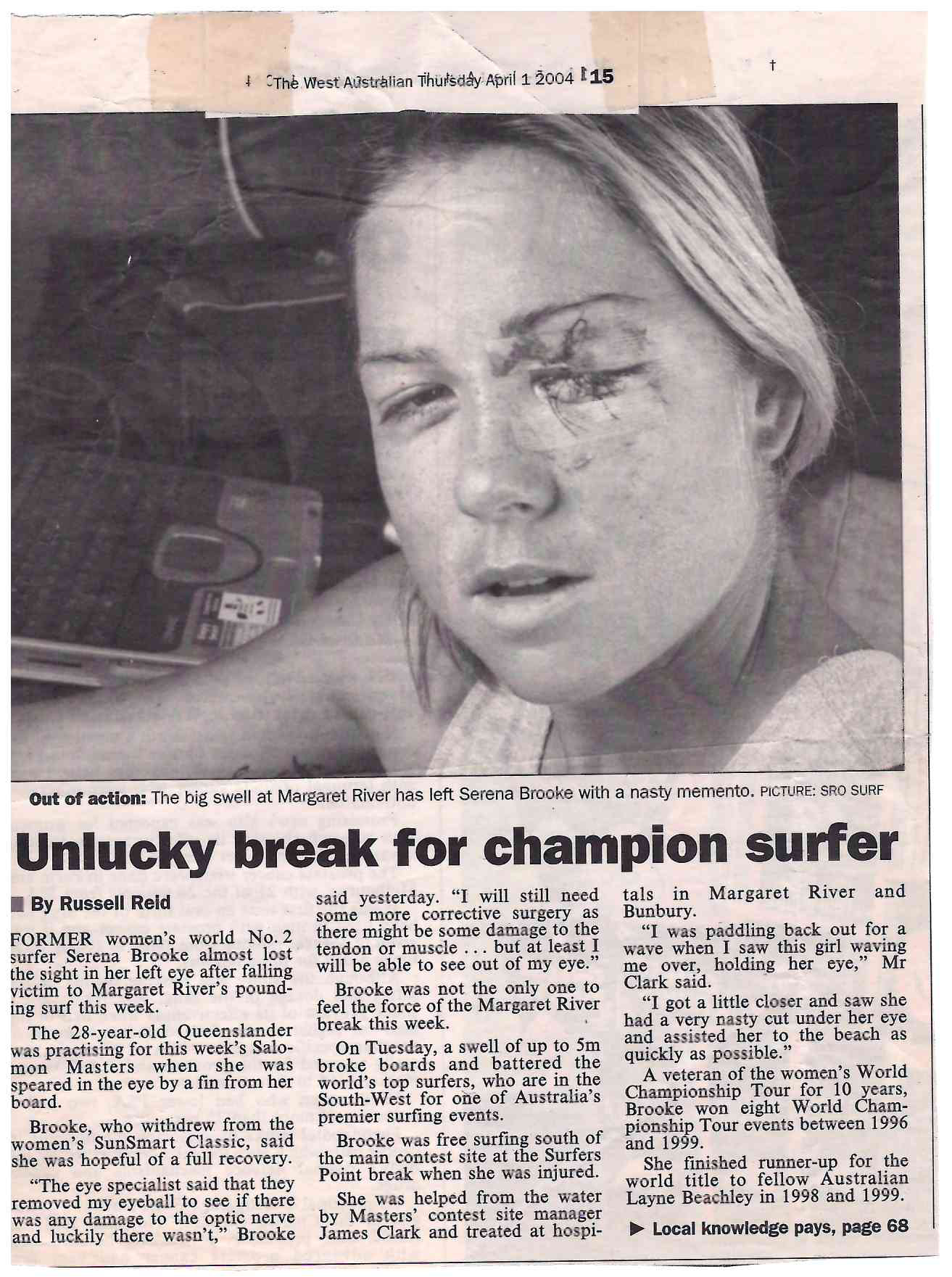
Unlucky break for champion
The West Australian Thursday April 1 2004
By Russell Reid
FORMER women’s world No. 2 surfer Serena Brooke almost lost the sight in her left eye after falling victim to Margaret River’s pounding surf this week. The 28-year-old Queenslander was practising for this week’s Salomon Masters when she was speared in the eye by a fin from her board.
Brooke, who withdrew from the women’s SunSmart Classic, said she was hopeful of a full recovery. “The eye specialist said that they removed my eyeball to see if there was any damage to the optic nerve and luckily there wasn’t,” Brooke said yesterday. “I will still need some more corrective surgery as there might be some damage to the tendon or muscle… but at least I will be able to see out of my eye.”
Brooke was not the only one to feel the force of the Margaret River break this week. On Tuesday, a swell of up to 5m broke boards and battered the world’s top surfers, who are in the South-West for one of Australia’s premier surfing events.
Brooke was free surfing south of the main contest site at the Surfers Point break when she was injured. She was helped from the water by Masters’ contest site manager James Clark and treated at hospitals in Margaret River and Bunbury.
“I was paddling back out for a wave when I saw this girl waving me over, holding her eye,” Mr Clark said. “I got a little closer and saw she had a very nasty cut under her eye and assisted her to the beach as quickly as possible.”
A veteran of the women’s World Championship Tour for 10 years, Brooke won eight World Championship Tour events between 1996 and 1999. She finished runner-up for the world title to fellow Australian Layne Beachley in 1998 and 1999.
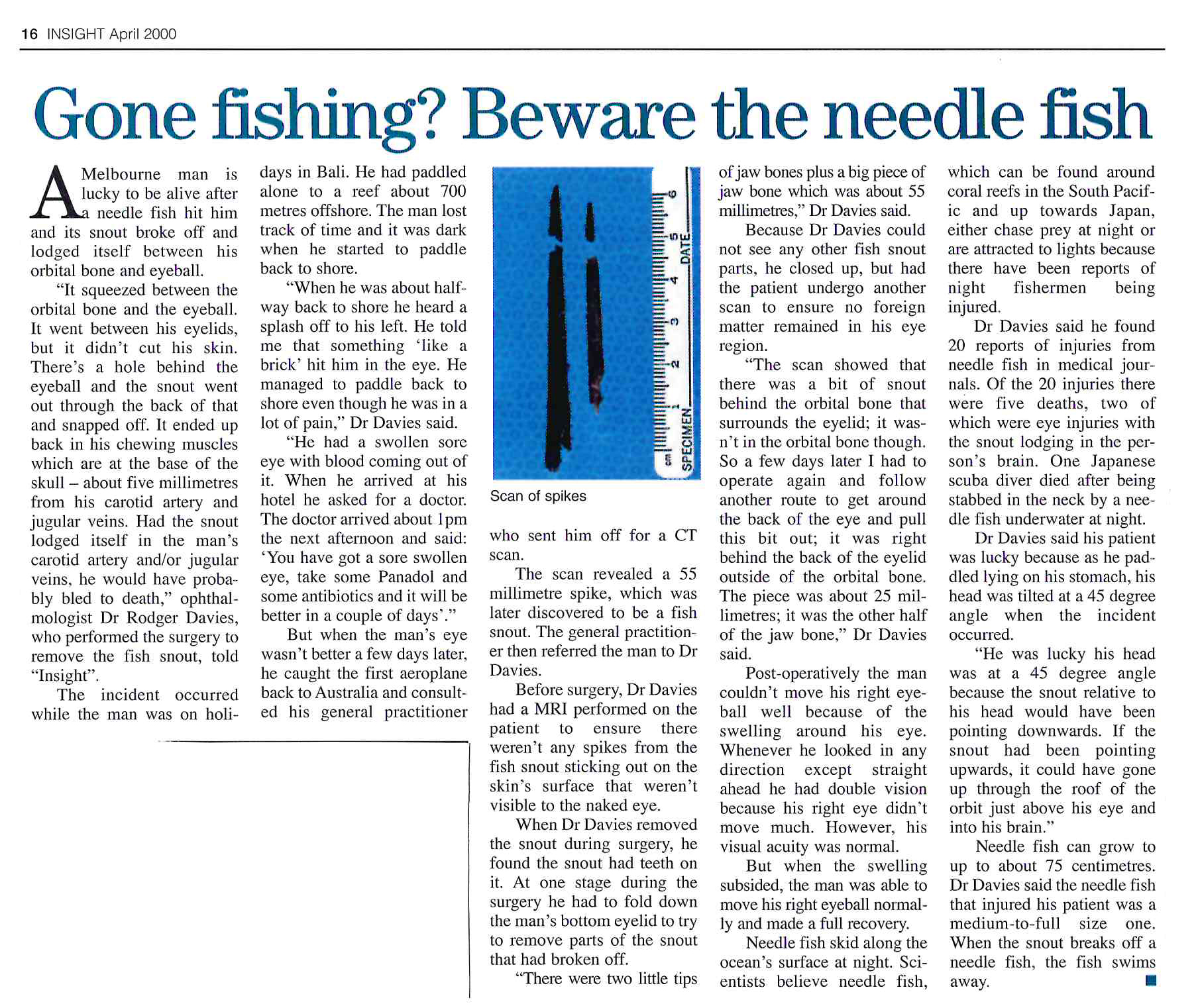
Gone fishing? Beware the needle fish
INSIGHT April 2000
A Melbourne man is lucky to be alive after a needle fish hit him and its snout broke off and lodged itself between his orbital bone and eyeball.
“It squeezed between the orbital bone and the eyeball. It went between his eyelids, but it didn’t cut his skin. There’s a hole behind the eyeball and the snout went out through the back of that and snapped off. It ended up back in his chewing muscles which are at the base of the skull about five millimetres from his carotid artery and jugular veins. Had the snout lodged itself in the man’s carotid artery and/or jugular veins, he would have probably bled to death,” ophthalmologist Dr Rodger Davies, who performed the surgery to remove the fish snout, told “Insight”.
The incident occurred while the man was on holidays in Bali. He had paddled alone to a reef about 700 metres offshore. The man lost track of time and it was dark when he started to paddle back to shore.
“When he was about halfway back to shore he heard a splash off to his left. He told me that something ‘like a brick’ hit him in the eye. He managed to paddle back to shore even though he was in a lot of pain,” Dr Davies said. “He had a swollen sore eye with blood coming out of it. When he arrived at his hotel he asked for a doctor. The doctor arrived about 1pm the next afternoon and said: ‘You have got a sore swollen eye, take some Panadol and some antibiotics and it will be better in a couple of days’.”
But when the man’s eye wasn’t better a few days later, he caught the first aeroplane back to Australia and consulted his general practitioner who sent him off for a CT scan. The scan revealed a 55 millimetre spike, which was later discovered to be a fish snout. The general practitioner then referred the man to Dr Davies.
Before surgery, Dr Davies had a MRI performed on the patient to ensure there weren’t any spikes from the fish snout sticking out on the skin’s surface that weren’t visible to the naked eye. When Dr Davies removed the snout during surgery, he found the snout had teeth on it. At one stage during the surgery he had to fold down the man’s bottom eyelid to try to remove parts of the snout that had broken off.
“There were two little tips of jaw bones plus a big piece of jaw bone which was about 55 millimetres,” Dr Davies said. Because Dr Davies could not see any other fish snout parts, he closed up, but had the patient undergo another scan to ensure no foreign matter remained in his eye region.
“The scan showed that there was a bit of snout behind the orbital bone that surrounds the eyelid; it wasn’t in the orbital bone though. So a few days later I had to operate again and follow another route to get around the back of the eye and pull this bit out; it was right behind the back of the eyelid outside of the orbital bone. The piece was about 25 millimetres; it was the other half of the jaw bone,” Dr Davies said.
Post-operatively the man couldn’t move his right eyeball well because of the swelling around his eye. Whenever he looked in any direction except straight ahead he had double vision because his right eye didn’t move much. However, his visual acuity was normal. But when the swelling subsided, the man was able to move his right eyeball normally and made a full recovery.
Needle fish skid along the ocean’s surface at night. Scientists believe needle fish, which can be found around coral reefs in the South Pacific and up towards Japan, either chase prey at night or are attracted to lights because there have been reports of night fishermen being injured. Dr Davies said he found 20 reports of injuries from needle fish in medical journals. Of the 20 injuries there were five deaths, two of which were eye injuries with the snout lodging in the person’s brain. One Japanese scuba diver died after being stabbed in the neck by a needle fish underwater at night.
Dr Davies said his patient was lucky because as he paddled lying on his stomach, his head was tilted at a 45 degree angle when the incident occurred. “He was lucky his head was at a 45 degree angle because the snout relative to his head would have been pointing downwards. If the snout had been pointing upwards, it could have gone up through the roof of the orbit just above his eye and into his brain.”
Needle fish can grow to up to about 75 centimetres. Dr Davies said the needle fish that injured his patient was a medium-to-full size one. When the snout breaks off a needle fish, the fish swims away.
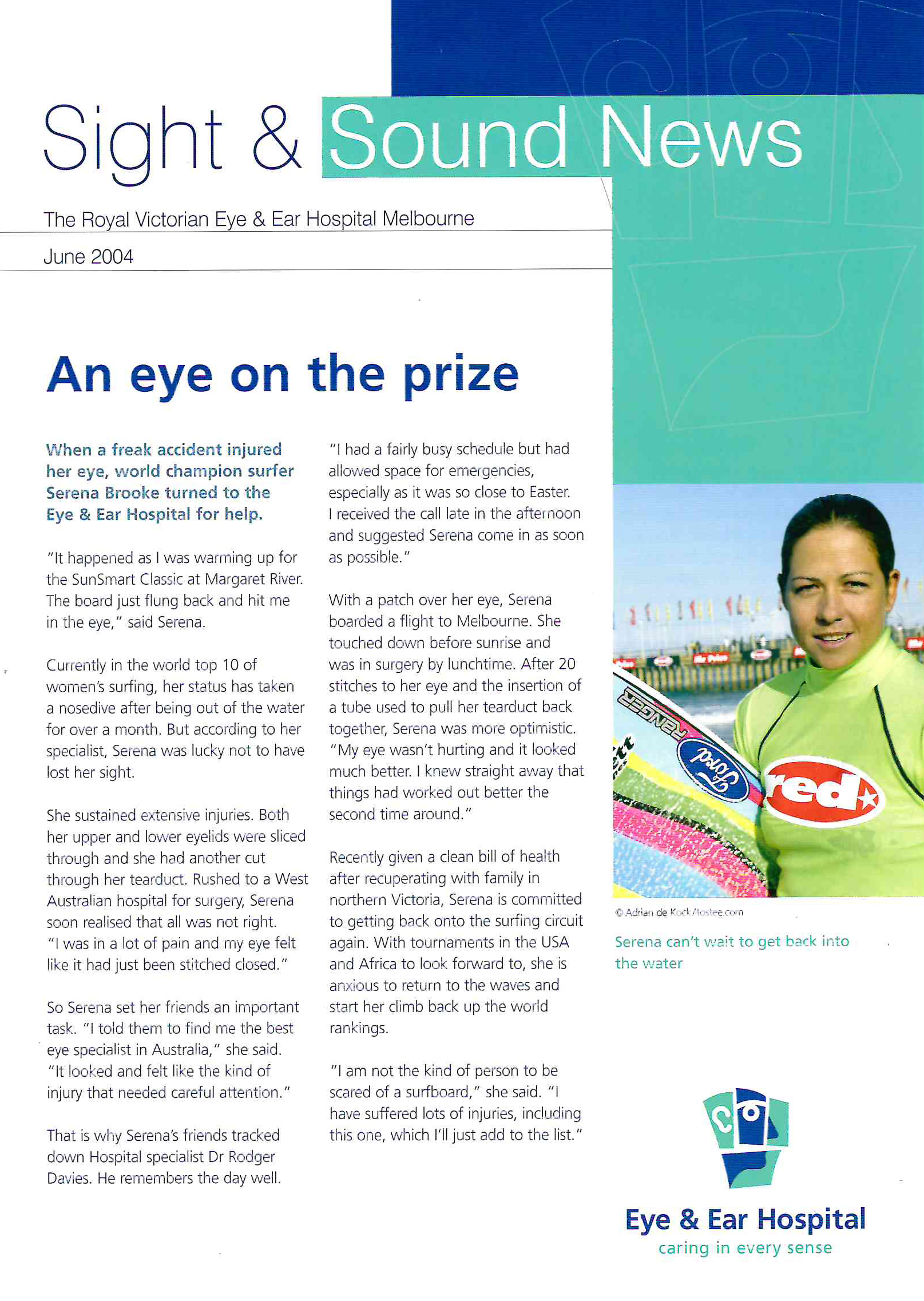
An eye on the prize
Sight & Sound News
The Royal Victorian Eye & Ear Hospital Melbourne June 2004
When a freak accident injured her eye, world champion surfer Serena Brooke turned to the Eye & Ear Hospital for help. “It happened as I was warming up for the SunSmart Classic at Margaret River. The board just flung back and hit me in the eye,” said Serena.
Currently in the world top 10 of women’s surfing, her status has taken a nosedive after being out of the water for over a month. But according to her specialist, Serena was lucky not to have lost her sight.
She sustained extensive injuries. Both her upper and lower eyelids were sliced through and she had another cut through her tearduct. Rushed to a West Australian hospital for surgery, Serena soon realised that all was not right. “I was in a lot of pain and my eye felt like it had just been stitched closed.”
So Serena set her friends an important task. “I told them to find me the best eye specialist in Australia,” she said. “It looked and felt like the kind of injury that needed careful attention.” That is why Serena’s friends tracked down Hospital specialist Dr Rodger Davies. He remembers the day well.
“I had a fairly busy schedule but had allowed space for emergencies, especially as it was so close to Easter. I received the call late in the afternoon and suggested Serena come in as soon as possible.”
With a patch over her eye, Serena boarded a flight to Melbourne. She touched down before sunrise and was in surgery by lunchtime. After 20 stitches to her eye and the insertion of a tube used to pull her tearduct back together, Serena was more optimistic. “My eye wasn’t hurting and it looked much better. I knew straight away that things had worked out better the second time around.”
Recently given a clean bill of health after recuperating with family in northern Victoria, Serena is committed to getting back onto the surfing circuit again. With tournaments in the USA and Africa to look forward to, she is anxious to return to the waves and start her climb back up the world rankings.
“I am not the kind of person to be scared of a surfboard,” she said. “I have suffered lots of injuries, including this one, which I’ll just add to the list.”
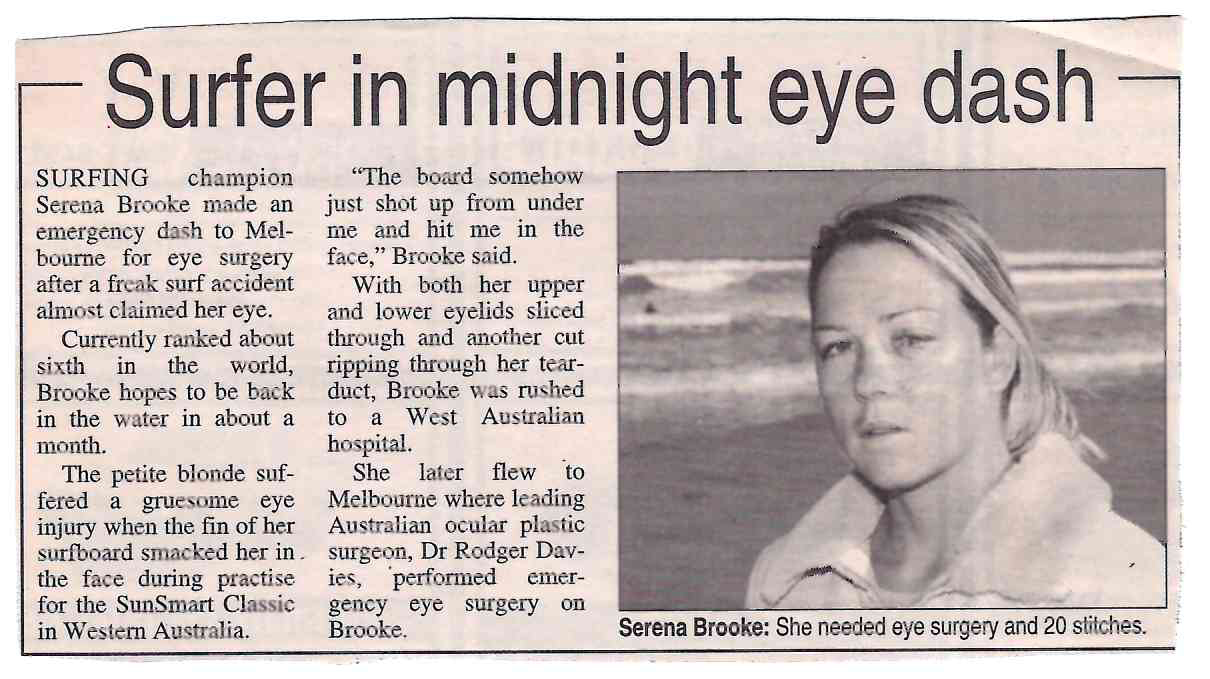
Surfer in midnight eye dash
SURFING champion Serena Brooke made an emergency dash to Melbourne for eye surgery after a freak surf accident almost claimed her eye. Currently ranked about sixth in the world, Brooke hopes to be back in the water in about a month.
The petite blonde suffered a gruesome eye injury when the fin of her surfboard smacked her in the face during practise for the SunSmart Classic in Western Australia. “The board somehow just shot up from under me and hit me in the face,” Brooke said.
With both her upper and lower eyelids sliced through and another cut ripping through her tear-duct, Brooke was rushed to a West Australian hospital. She later flew to Melbourne where leading Australian ocular plastic surgeon, Dr Rodger Davies, performed emergency eye surgery on Brooke.